Showing posts with label Caribbean. Show all posts

Friday, January 18, 2008

NEWS ~ Avian Bird Flu in Haiti?

When countries like Haiti make the excruciatingly slow climb out of poverty and corruption, an apparently minor hitch could have disastrous implications on that plodding progress. Today, the Sun Sentinel ran an op-ed on the potentially devastating impact of Avian Flu, now making the rounds in the Caribbean, on Haiti.

While Puerto Rico, a U.S. protectorate, can probably easily weather any disruption in trade between itself and Dominican Republic, Caribbean countries - like Haiti - without the safety net of the U.S. economy, will suffer. The Sentinel writes, "egg prices in Port-au-Prince jumped 25 percent to more than $3 a carton, according to news reports." Little fluxes like these, with high gasoline prices effecting costs too, present terrible difficulties to the majority of Haitians, whose meager incomes place them well below the poverty line.

Though the strain found in the DR is less virulent than that recently found in Asia, the Sun Sentinel's editorial board rightly points out that
Haiti can't bear this now — not while making slow, but what appears to be steady progress under President René Préval. The country imports at least 1 million eggs and hundreds of thousands of chickens from the Dominican Republic daily, according to the country's agriculture minister. A bird flu epidemic and food shortage would further stress a population whose health is already compromised. It could also wipe out a means of livelihood for merchants who sell poultry products.
Some might remember the last animal-related food disaster to impact Haiti: the slaughter of the Creole Pigs. When the African Swine Fever virus spread to Haiti from the Dominican Republic, the U.S. government put enormous pressure on the Haitian government to slaughter all their pigs - offering a seemingly excellent eradication and re-population plan. Thus, Creole Pigs were slaughtered and U.S. shipped in pigs from the Midwest. But the American swine were higher maintenance, requiring imported feed, clean water and falling ill more often. The program failed disastrously and had lasting and continuing impacts on poor farmer.

I would like to under second the Sun Sentinels recommendation that: "The United Nations, USAID and other humanitarian organizations must do everything in their power to help address the problem before the situation worsens."

Friday, July 27, 2007

Tortured Contrasts

An old woman sits on a hill situated slightly west of Port Salut. A crop of dying sugar cane surrounds her and her rusty tin hut, which is no larger than a spacious outhouse. She sits facing away from this scenery, toward the road. She has a panoramic view of the southern Caribbean but not desire or ability to enjoy it. Only a few other thatched-roof huts speckle the landscape; each has a stunning coastal view and a resident blinded by poverty and structural violence. Haiti has stretches of coast with little or no development. The few beaches near more populated, waterfront towns are usually destroyed or literally covered with trash. With recent improvements to infrastructure (better bridges, paved roads, electricity) and slow but steady economic growth, the facts about this devastated Caribbean island could change. Miles of empty, turquoise water do not promise change any time soon, though. Even with some real achievements in national monetary policies and with GDP growth creeping ever higher, the government must still face major socioeconomic challenges. Human rights violations remain Haiti's greatest plague. This lingering and gruesome quality of a long-unstable government is painfully visible everywhere in the country and creates a stark contrast to the dazzling colors and uninterrupted panoramas.

Thursday, March 29, 2007

in the Caribbean world...

In the silent, moonlit, Haitian evening, Gabriel Garcia Marquez’s Caribbean of magical realism springs to life. A thin and shrill voice emerges in the silence – then, the sound of shrieking and metal doors rattling. Someone is having a “satanic fit.” The spirits will leave him but until then, he will pass hours in writhing agony, women will try to restrain him, douse him with water, tap him with special branches. Finally, he will heave one more tortured sigh and pass into sleep.

The conversation after a night like this turns to voodoo and the magical realism of the Caribbean. Whether people here are more in touch with a realm that we, with all our technology and electricity have forgotten, or whether a lack of education promulgates these beliefs, something supernatural here feels very real.

The people recount their tales in circular patterns – disregarding linear understanding. Chinua Achebe does this in telling the story of his people in West Africa, Things Fall Apart. This device – one used by the oral storytellers – helps him express his people’s culture in a complete way. The Haitian people, most of whom can claim West Africa as their “Pays Natal,” to borrow from Aimé César’s terminology, have clearly never lost this aspect of their culture of origin. A doctor, trying to diagnose a stomachache, asks a grown man how long he has been throwing up. He responds a day, a year, he cannot remember but it has been too long. He moans in pain. His telling is circular in his memory of the pain.

In the midst of all this, the “blan” bring aid, medicine and technology. A man from Kansas opens a birthing clinic close to the middle of nowhere, but not quite. The “Maison de Naissance” offers good pre and post-natal care. Some regular medical practices that women all over the fully “developed” world tend to enjoy are offered but regarded skeptically by the Haitian women who given birth, rest for a few hours, then pick up their babies and walk the dusty road home in the blazing sun. A kid is cursed by a purported witch and goes blind. He awakes in the morning and sees nothing. He is terrified. He goes to the best ENT hospital in Haiti. The doctor, shaking his head, declares there is nothing physically wrong with the boy. A priest gives in. He blesses the kid; he anoints him, prays over him and says that his sight will return slowly. And surely and slowly, he begins to see light, then shapes, then details. The spell is broken.

Well into the complete darkness of a Haitian night, a child screams. To ignorant ears, it sounds like a case of serious abuse. But security is already there, making sure everyone is OK. He is standing, smiling. When a doctor appears at the scene of the satanic attack, the people seem baffled. Why would he need medical attention? His affliction is not of this world. The doctor observes for a moment and shuffles back to bed. In the morning, she checks up on him and they all laugh. Of course, he is fine!
In the shadow of old and craggy mountains, Haitians are born, grow, live and die. For many, tucked away along impassable roads over mountain passes, much of the outside world will remain hidden. In song, one cries out, “when will God reveal to me my purpose; His will for my life?”

Monday, January 08, 2007

hope and beauty in Haiti

Imagine a little boy with HIV. Imagine he lives in a country where no clinic will treat him without extensive tests. He has no family and no means to pay for treatment. He is loveable, sweet – with an adoring smile and laughing eyes, easy to love. He helps when asked and enjoys a place of relative favoritism with those who care for him. He is sick and, yet, he is loved. Because love means trying despite everything and sometimes when all that remains is hope. Haiti is a devastatingly beautiful country, especially the southern regions. Camp Perrin is in the mountains just north of Les Cayes. Drive out of Les Cayes and into the hills. Tobacco farms and pastures line the bumpy dirt road and mountains rise in the close distance. Children wander about, curling their fingers at passers-by. A woman ambles amongst the cows and sheep in a field; old men guide goats and donkeys along the roadside.A right turn toward Camp Perrin and the path grows steeper. Country gives way to town and houses spring up one after the other, some with tin roofs and others thatched. The truck turns onto a narrow path, strewn with rocks and emerges onto a riverbed, dry until the rainy season. Across the white-hot river lie a series of houses, tucked away and clinging to the mountainside. The inhabitants are mirthful, surprisingly so, and proud of their tiny corners.Back in the town of Camp Perrin, a market bustles with vendors selling seasonable vegetables and fruits, dried herring and trinkets. One woman slices into fresh ginger bread from which roots peek out and steam rises. Higher in the hills, the noises of town fade and give way to a wealthier area; the roads are paved. An Oblate school and mission covers a good amount of acreage where coffee plants, orchids, hibiscus and poinsettias flourish. To the back of the property reside pigs, chickens and rabbits.Camp Perrin is also home to the first Ecole Espwa. An old warehouse turned schoolhouse struggles to stave off rain. But children still come to learn and from this land originate many of the first kids taken in by Fr. Marc and Pwoje Espwa. Many of these now live, study, and work down in the coastal planes of Castel Pere at the Pwoje Espwa farm.

To the east of Castel Pere, down a long paved road built by the Haitian government in conjunction with the Taiwanese government, sits Port Salut. This paradise, unimaginable until witnessed, lies at the bottom of a winding mountain road, lined with colonial ruins and breathtaking views of tropical valleys and seascapes. The sandy beaches stretch along an aqua blue coastline where cars and people congregate to enjoy the day. Men sit weaving fishing nets while others slowly paddle the length of the shore.To know Haiti is to love it. No amount of writing or photographs can portray this. The Haitians say “Haiti Cherie” and are fiercely and justly proud of this land. But the people are so poor and the poverty so devastating. A Haitian man who taught a friend of ours stopped to talk to us on the way to market one day. He wanted to know how we, as Americans, could find his country beautiful. We tried to explain that between the natural beauty and the beauty of the people, it was impossible not to love Haiti. He replied, “ah, yes, the beauty of the people…”

The kids at Pwoje Espwa are, like the country in which they were born, impossible not to love. Their carefree laughter in the face of situations American children could rarely fathom, their smiles, love, intelligence, talent, dancing, patience and, above all, their hope make them endearing.

We learned, last night, of an expression often employed by Haitian children when faced with a departing friend or caretaker: “do not forget me.” They expect abandonment. The response is easy, “pa capab” (not possible) or simply “you are in my heart.”

Monday, October 09, 2006

Across the Shining Sea

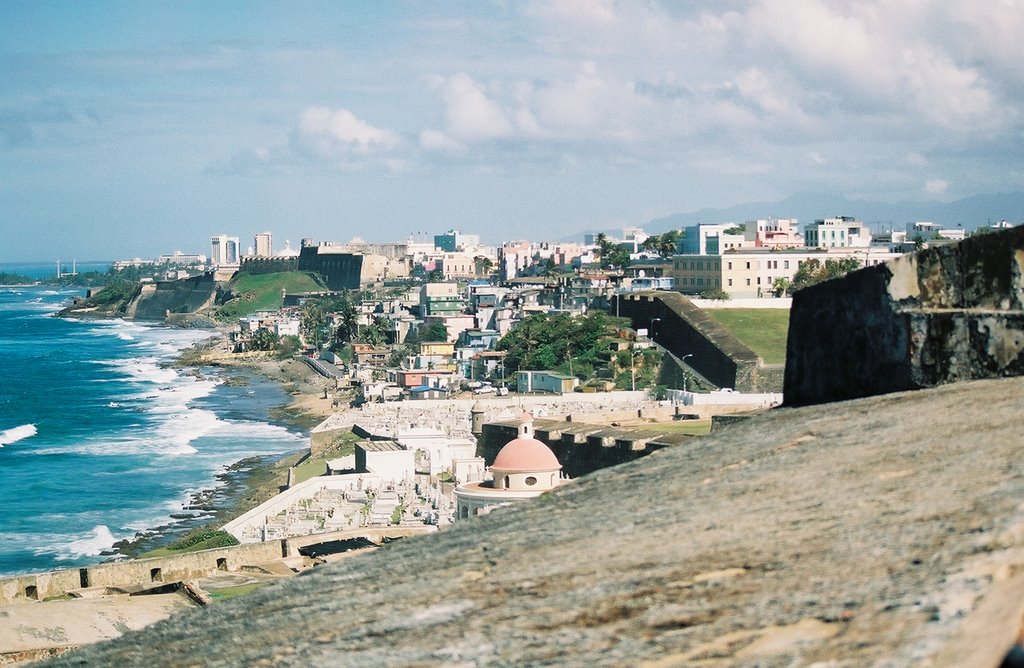
Taken from atop "el Morro," the common name for Fort San Felipe del Morro in Old San Juan, Puerto Rico, this photograph shows ancient gravestones, the old Spanish-style city, the taller modern city and hazy mountains all set on a bay bluer than any gem. Standing here and looking out at this vista, one can imagine why men bled for this land.

A brief comparison helps in understanding this island and its neighbors. Some of the vital stats of the Caribbean islands:

Haiti (independence from France 1804) - $1,700/capita; life expectancy 53 yrs.
Martinique (department of France) - $14,400/capita; life expectancy 79 yrs.
Guadeloupe (department of France) - $7,900/capita; life expectancy 78 yrs.
^Dominican Republic (independence from Haiti 1844) - $7,000/capita; life expectancy 71 yrs.
Cuba (independence from Spain 1898) - $3,500/capita; life expectancy 77 yrs.
^Puerto Rico (unincorporated US territory) - $18,600/capita; life expectancy 78 yrs.
Jamaica (independence from UK 1962) - $4,400/capita; life expectancy 73 yrs.
The Bahamas (independence from UK 1973) - $20,200/capita; life expectancy 65 yrs.
St. Lucia (independence from UK 1979) - $5,400/capita; life expectancy 74 yrs.
Barbados (independence from UK 1966) - $17,000/capita; life expectancy 73 yrs.
Trinidad and Tobago (independence from UK 1962) - $16,700/capita; life expectancy 67 yrs.

^initially, Spanish colonies

For comparison:

United States (independence from UK 1776) - $41,800/capita; life expectancy 78 yrs.*

Of course - the list above omits Aruba and the Virgin Islands - and these wealthier still than Puerto Rico in GDP/capita. The former gained independence in the 1980s from the Netherlands and the latter are governed by the UK and USA. These islands still follow in the trend. Perhaps it was the organization system set up by the Brits, or the fact that they stubbornly held on to their colonies the longest but those islands that were under British rule seem generally better off.

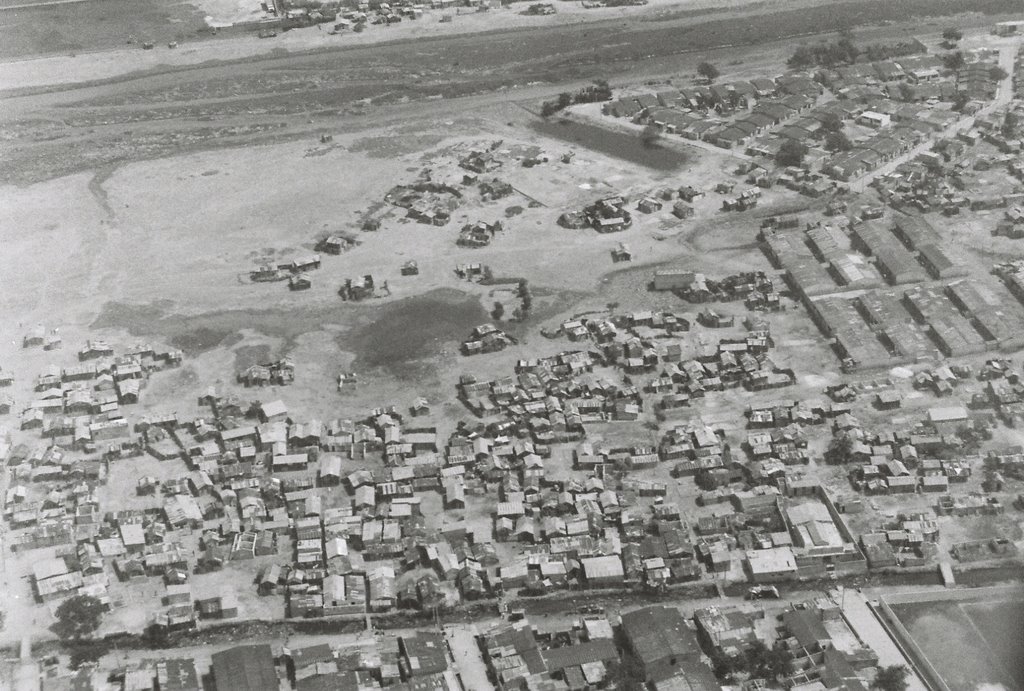
The study of "Europe and its Others" could take longer than a lifetime - but a look at some stats and a visit to some of these "Others" reveals something of state of affairs in these countries before their liberation. Looking at a picture of Haiti's capital lays bare the painful difference between a (comparatively) wealthy island and the poorest of the islands.

The Caribbean islands explode with color and music, lush jungles and craggy mountains. The music - from Salsa to Reggae to Copa - exudes the contagious spirit of the people. Though my travels within the Caribbean have taken me only to the poorest of Western nations (Haiti) and to Puerto Rico - drinking the coffee, sipping the rum, tasting the fruit and talking with the people betrays a potential that none of these islands have reached.

*from the CIA World Factbook
photos by Portia!