Imagine a little boy with HIV. Imagine he lives in a country where no clinic will treat him without extensive tests. He has no family and no means to pay for treatment. He is loveable, sweet – with an adoring smile and laughing eyes, easy to love. He helps when asked and enjoys a place of relative favoritism with those who care for him. He is sick and, yet, he is loved. Because love means trying despite everything and sometimes when all that remains is hope.


Haiti is a devastatingly beautiful country, especially the southern regions. Camp Perrin is in the mountains just north of Les Cayes. Drive out of Les Cayes and into the hills. Tobacco farms and pastures line the bumpy dirt road and mountains rise in the close distance. Children wander about, curling their fingers at passers-by. A woman ambles amongst the cows and sheep in a field; old men guide goats and donkeys along the roadside.


A right turn toward Camp Perrin and the path grows steeper. Country gives way to town and houses spring up one after the other, some with tin roofs and others thatched. The truck turns onto a narrow path, strewn with rocks and emerges onto a riverbed, dry until the rainy season.


Across the white-hot river lie a series of houses, tucked away and clinging to the mountainside. The inhabitants are mirthful, surprisingly so, and proud of their tiny corners.


Back in the town of Camp Perrin, a market bustles with vendors selling seasonable vegetables and fruits, dried herring and trinkets. One woman slices into fresh ginger bread from which roots peek out and steam rises. Higher in the hills, the noises of town fade and give way to a wealthier area; the roads are paved. An Oblate school and mission covers a good amount of acreage where coffee plants, orchids, hibiscus and poinsettias flourish.


To the back of the property reside pigs, chickens and rabbits.


Camp Perrin is also home to the first Ecole Espwa. An old warehouse turned schoolhouse struggles to stave off rain. But children still come to learn and from this land originate many of the first kids taken in by Fr. Marc and Pwoje Espwa. Many of these now live, study, and work down in the coastal planes of Castel Pere at the Pwoje Espwa farm.
To the east of Castel Pere, down a long paved road built by the Haitian government in conjunction with the Taiwanese government, sits Port Salut.


This paradise, unimaginable until witnessed, lies at the bottom of a winding mountain road, lined with colonial ruins and breathtaking views of tropical valleys and seascapes.

The sandy beaches stretch along an aqua blue coastline where cars and people congregate to enjoy the day. Men sit weaving fishing nets while others slowly paddle the length of the shore.
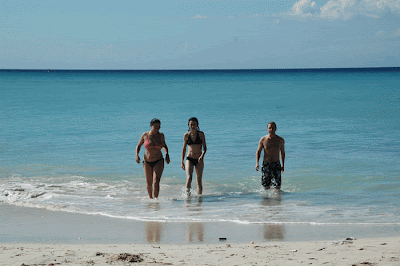
To know Haiti is to love it. No amount of writing or photographs can portray this. The Haitians say “Haiti Cherie” and are fiercely and justly proud of this land. But the people are so poor and the poverty so devastating. A Haitian man who taught a friend of ours stopped to talk to us on the way to market one day. He wanted to know how we, as Americans, could find his country beautiful. We tried to explain that between the natural beauty and the beauty of the people, it was impossible not to love Haiti. He replied, “ah, yes, the beauty of the people…”
The kids at Pwoje Espwa are, like the country in which they were born, impossible not to love. Their carefree laughter in the face of situations American children could rarely fathom, their smiles, love, intelligence, talent, dancing, patience and, above all, their hope make them endearing.
We learned, last night, of an expression often employed by Haitian children when faced with a departing friend or caretaker: “do not forget me.” They expect abandonment. The response is easy, “pa capab” (not possible) or simply “you are in my heart.”
 The countryside never hints at the 21st century. Neither modern structures nor sounds of industry interrupt the serene poverty. The sensation is at once as beautiful as it is tragic. Did time along with everything and everyone else just forget this corner of the world?
 A woman prepares peanuts on the top of tomb of someone she most likely knew. This evening, her younger brothers will probably sit on the same tomb with a bottle of clarin (Haitian moonshine) and talk loudly into the night sky. Life goes on here, despite the lack of technological crap and electricity and cars and screened windows and tiled floors and three story houses and 7-11s, with persistence and passion.


